- Knowledge Base
- Assets
- Locations
- What are asset locations
- How to add a run
- How to edit a run
- How to mark a run as complete
- How to archive a run
- How to delete a run
- How to change the assignee
- How to add a result in a checklist run
- How to add bulk results in a checklist run
- How to share run tasks with external participants
- How to generate an Excel or PDF report from a checklist run
- How to filter the run tasks view
- What is an office asset
- How to create a new asset
- How to manage an asset
- How to move an asset
- How to dispose of an asset
- How to transfer (in) an asset
- How to transfer (out) an asset
- How to log a sighting of an asset
- How to log an inspection of an asset
- How to log maintenance on an asset
- How to export a record of an asset
- How to print asset labels
- Introduction
- Admissions
- Assets
- Bank Accounts
- Boards
- Business Trips
- Candidates
- Checklists
- Clients
- Companies
- Consents
- Contacts
- Contracts
- Custom Forms
- Departments
- Documents
- Evaluations
- Employee Performance
- GL Accounts
- Incoming Center
- Integrations/External Systems
- Invoices
- Job Management
- Key Dates
- Months
- Offices
- Personnel
- Polls
- Project Management
- Project Status
- Purchase Orders
- Schedule
- Shared Spaces
- Teams
- Time Off
- Time Tracking
- Transactions
- Vendors
- Mobile Application
- What is a personnel asset
- How to create a new asset
- How to manage an asset
- How to move an asset
- How to log inspection on an asset
- How to log maintenance on an asset
- How to dispose of an asset
- How to transfer (out) an asset
- How to transfer (in) an asset
- How to log a sighting on an asset
- How to print asset labels
- How to export a record of an asset
- What is a project asset
- How to create a new asset
- How to manage an asset
- How to move an asset
- How to log inspection on an asset
- How to log maintenance on an asset
- How to dispose of an asset
- How to transfer (out) an asset
- How to transfer (in) an asset
- How to log a sighting of an asset
- How to print asset labels
- How to export a record of an asset
- Project transactions
- How to record an estimate
- How to create a budget
- How to submit transaction items for approval
- How to approve or deny budgeting items from the transactions grid
- How to create a purchase order from approved estimates
- How to link approved estimates to approved budgets
- How to cancel a transaction
- How to deactivate a transaction
- How to edit a transaction
- How to re-submit a denied transaction
What are asset locations
Asset locations refer to the physical locations where tangible assets are located within a business or organization. Accurately tracking asset locations is important for inventory management, maintenance and repair, and overall operational efficiency.
To see asset locations, expand the sidebar menu and click on the Locations tab.
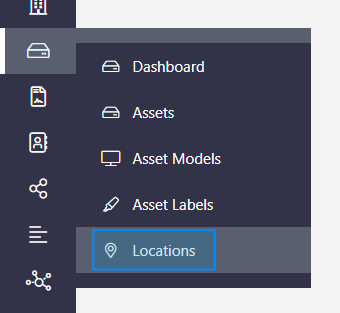
The Locations page will open. You will be presented with information about the name of the location, the number of assets in the location, the last change in the location, the state of the location, etc. You can also create a new location directly from this page.

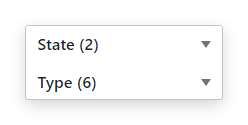
You can use the filter to quickly find a location, or alternatively can start typing into the search field to find the location. Locations can be searched by the states of Active, Inactive, or both, as well as by type: In Use, In Storage, Out of Service, Disposed and External Location.
The information you can see will depend on your customization settings. In the Locations list, you can change and save the width of the columns in the grid itself. Click  to save the changes.
The columns in the grid are optional and are based on your configuration. Click the link to find out how to customize the list view.

You can see the following information from the locations view:
- Name – The name of the location. This could include the name of the building, floor number, etc.
- Assets – The number of assets in the location. You can view the total number of assets assigned to the location.
- State – This shows whether the location is active or inactive.
- Type – The location type: In Use, In Storage, Out of Service, Disposed, External Location and Unknown.
- Path – This describes the location details. Click on Path to open the parent location.
- Code – A code which will identify the new location. If the new location has a parent location, the code will be populated. For example, when a building has a code, if you add a new location within the building, the code will be populated.
- External Id – The external identifier.
- Last Change – This will show how long ago the last change to the location was made and by whom.
Note! Vault Synapse is a highly customizable tool, meaning certain parts and functionalities of the application can be additionally built-in or customized based on your business needs and preferences.
Was this article helpful?
Didn’t find what you were looking for?
Contact us and we’ll build the right solution for you. Vault Synapse can be fully customized based on your business needs.